In brief
Pocket depth is the detail you are most likely to find, on 22 of 27 pages. Fabric weight and the place the cotton or flax was grown are the rarest, at 5 pages each. A certificate named with its number shows up on 10 pages (survey CSV). Thread count, trial window and sewing country fall in between. You are reading what makers declare. The claims were not checked here.
This guide is for: people comparing organic or linen sheet sets who want to know which specs a product page will give them, and which they will have to ask for.
Key Takeaways
Here is what the count found, in brief. Fit details are common on these pages, while fabric weight and farm country share last place.
- 22 of 27 pages state the fitted sheet's pocket depth, the most common detail in the count (survey CSV).
- 5 of 27 pages state the fabric weight, and just as few say where the cotton or flax was grown (survey CSV).
- 10 of 27 pages name a certificate together with its number. That number is what lets you look the claim up yourself (survey CSV).
How many sheet set makers list each detail?
Most makers print the fitted sheet's pocket depth. Very few print the fabric weight or name the farm country where the fiber grew.
Each row below comes from the survey CSV. You can sort it as you like.
| What the page was checked for | Pages that state it | Share of 27 |
|---|---|---|
| The fitted sheet's pocket depth | 22 | 81% |
| The country it is woven or sewn in | 18 | 67% |
| A trial or return window in nights or days | 17 | 63% |
| A thread count | 16 | 59% |
| A certificate named with its number | 10 | 37% |
| The fabric weight | 5 | 19% |
| Where the cotton or flax was grown | 5 | 19% |
Our count: we read 27 makers' product pages on 2026-11-11, and every one could be read (survey CSV). The questions fall into three buckets.
- Common, on more than half the pages: pocket depth, sewing country, trial window and thread count, on 16 to 22 pages (survey CSV).
- Middle, on a third to a half: a certificate named with its number, on 10 pages (survey CSV).
- Rare, on under a fifth: fabric weight and growing country, on 5 pages each (survey CSV).
These pages cover fit and returns far more than the cloth itself. You will often need to ask how heavy a sheet is. Ask where its fiber grew, too. Each section below takes one detail and explains why it shows up, or why it does not.
How were the pages read, and what does the count leave out?
Each page was saved as read, and a yes needed a quote on the page. The count shows what makers declare, not whether any claim is true.
The sets were organic or natural cotton and linen, all sold to US buyers. Each set was read on its maker's own product page. You will not find retailer listings in it. All the reading you see here happened on a single day. A copy of every page was kept. Every page faced the same questions you see in the table.
A page earned a yes only when the saved copy held a quote that answered the question. Vague wording did not count. A phrase like "deep pockets" names no depth, so it scored a no. The file shows each page's answers.
Here is what the count cannot say. It cannot say whether a stated figure is true. No sheet was weighed, measured or sent to a lab here. The file records what each maker declares. It says nothing about makers outside the list, or about labels and packaging.
Read a "no" in the file as "not on the product page that day." That is a narrower claim than "this maker does not know." A maker may answer your email when its page is blank. The pages you read can change, too. That is why every row in the file carries the read date. Before you rely on one figure, open the maker's page again. Check that it still says what the file records.
Why do most makers list the fitted sheet's pocket depth?
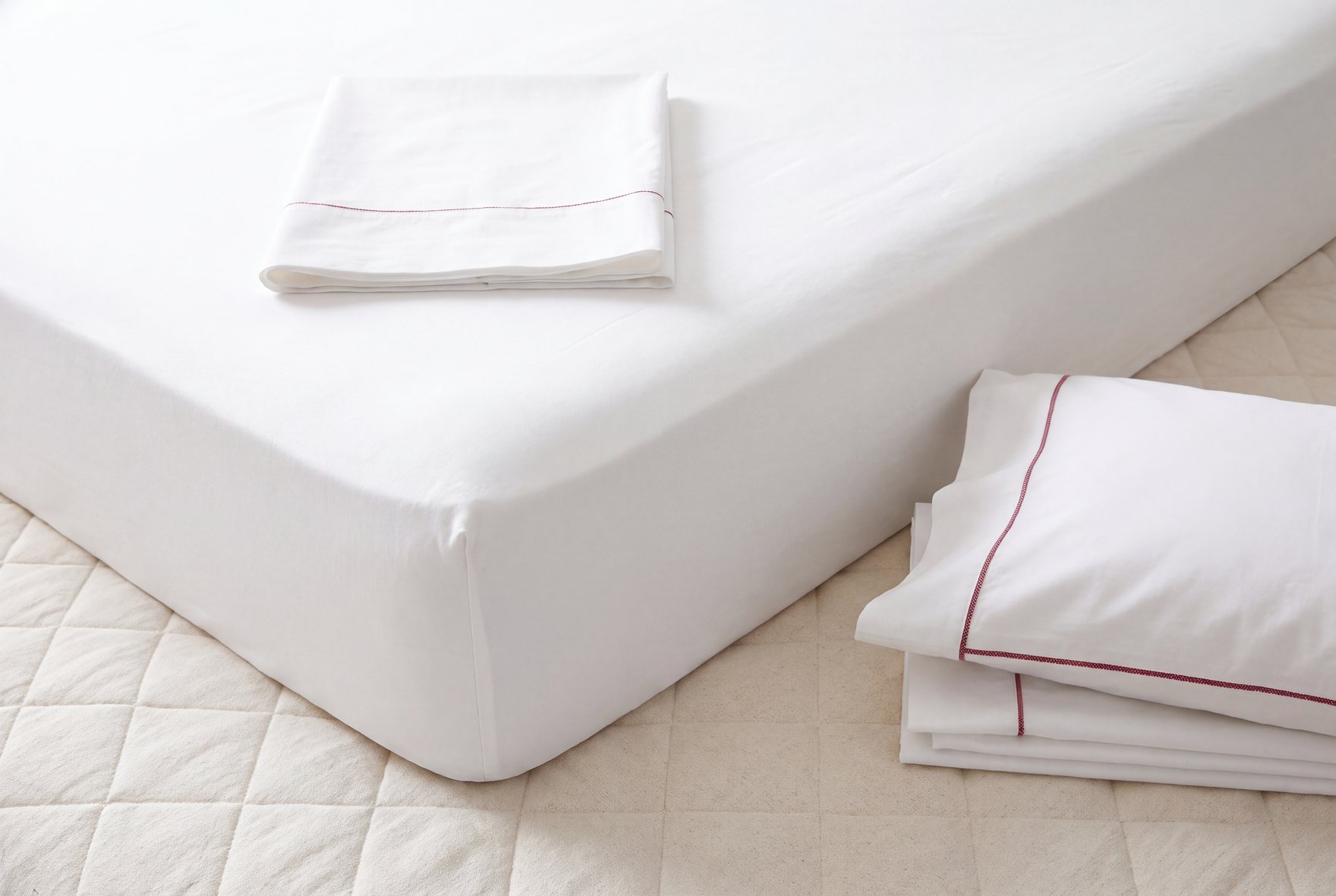
A fitted sheet has to reach around the mattress, so the pocket figure decides whether it fits. That makes it the detail sellers print most.
Pocket depth was the most common detail in the count (survey CSV). If a fitted sheet cannot reach around your mattress, it does not work at all. So makers print it. A shallow pocket pops off the corners. Your set then goes back as a return. That costs the maker. Our guide to the flat sheet and the fitted sheet explains how the two pieces differ.
You will see the figure given in two ways. Some pages state the depth of the side wall. Others state the tallest mattress the sheet will fit. A few give you both. One percale set lists its pocket depth and the mattress height it fits (Boll & Branch). Another maker sells a deep-pocket set for taller mattresses beside its standard sheets (Avocado).
| What the page states | What it tells you | Source |
|---|---|---|
| Pocket depth plus the mattress height it fits | Side wall and mattress height, both given | Boll & Branch |
| A taller mattress limit for its deep-pocket set than for its standard sheets | Two depths from one maker, by product | Avocado |
| "Deep pockets" with no figure | Nothing you can measure your bed against | This guide's reading rule, above |
These rows are examples, not a ranking. They show wording you will meet. To use any of them, measure your mattress height and add your topper. Then look for a pocket at least that deep.
Why do so few makers list the fabric weight?
Weight tells you how much cloth is in a square yard, which thread count cannot. Yet only a handful of the makers' pages print it at all.
As the table above shows, fabric weight was among the rarest details. Yet weight is the plainest number for how much cloth you buy. The textile test for it, an ASTM standard, covers fabric mass per unit area. You will usually see it in grams per square meter or ounces per square yard.
The count cannot tell you why. It does show thread count on far more pages. Weight and thread count tell you different things. A sheet woven from fine yarn can have a high count and still feel light on your bed. Do you run warm? Then weight may matter to you. Ask the maker for it in ounces per square yard or grams per square meter.
Compare weights only within one fiber and weave. A linen and a cotton percale of equal weight will not feel alike. Our linen sheets guide explains how linen cloth differs from cotton percale. That gives a weight figure context. It also helps you judge whether a heavier sheet suits the way you sleep.
Why is the fiber's growing country rarer than the sewing country?
US labeling law asks where a sheet was made, not where its fiber grew. That gap matches the count: sewing country common, farm country rare.
In the count, you find the sewing country on far more pages than the farm country. Federal rules explain much of that gap. Most textile labels must list fiber content, country of origin and the maker's identity (Reed Smith). For an imported sheet, the label names the country where it was processed or made (federal labeling rule, Cornell LII).
Under the textile rules, origin looks only one step back from the final making (Reed Smith). A household product maker has to flag imported cloth or yarn (Cornell LII). The textile rules also require origin disclosures online and in catalogs (Reed Smith). So a maker must know where your sheet was sewn. Telling you where the fiber grew is extra. Sharing it is the maker's choice.
When a page does state it, you get a short line. One maker writes that its cotton is "Grown on a family farm in India" (Boll & Branch). A linen seller names France as the place its flax was grown (I Love Linen).
A missing farm country does not mean the fiber is poor or hidden. You can still ask the maker where the fiber came from. Ask which certificate covers that stage, too. If it matters to you, ask.
What does a thread count tell you when the weight is missing?
A thread count tells you how many yarns sit in a square inch. It says little about yarn size, so without the weight it gives half a picture.
As the table shows, a thread count appeared on just over half the pages. You get the figure by counting yarns in both directions of the weave. It gives you density, little else. The ASTM test for it covers end and pick count in woven fabric (ANSI Webstore).
The weak point is ply. Ply means how many strands are twisted into each yarn. FTC enforcement staff warned that consumers "could be deceived or misled" when a count is multiplied by the plies (Home Textiles Today). The fair wording, staff said, gives you the count and then the ply (Home Textiles Today).
A thread count alone tells you density, not heft. Two sheets with equal counts can feel quite different to you. One may use thicker yarn. Put a weight beside the count. Then you can tell a fine, dense cloth from a coarse, open one. When the weight is missing, check whether the page states the ply. If it says nothing, ask.
Our guide on whether thread count is a marketing number goes further into what to read instead. It is a good next stop when your page gives a count and little else.
How do you look up a certificate number printed on a sheet set's page?
A certificate with its number can be looked up through the issuer's own online check. A logo without a number gives you much less to go on.
As the table shows, about a third of the pages named a certificate with its number. You will not find any of them reprinted here. This guide only tells you whether one was named.
On organic textiles, you will often see GOTS, the Global Organic Textile Standard. Ask which body certified the maker. Then check what the certificate covers. It should name the sheet you want, not only the company behind it.
OEKO-TEX Standard 100 works through its Label Check. You scan the code on the label or type in the certificate number (OEKO-TEX). Each certificate is issued for one year (OEKO-TEX). A check can come back valid, expired or withdrawn (Hohenstein).
So a number is worth more than a logo. With the number, you can confirm the certificate is current. You can also see what it covers. Without it, you have the maker's word and little else to go on.
What can you ask a maker when a detail is missing?
A missing detail can be one short email away. Ask for the figure, the unit and the place it comes from, then check it against the label.
The table below is this guide's own judgement of a useful follow-up for each gap. No maker publishes it.
| Missing from the page | What to ask | Where you can check the answer |
|---|---|---|
| Pocket depth | How deep is the fitted sheet's side wall, in inches, for my size? | Your mattress height plus topper |
| Fabric weight | What is the weight, in oz per square yard or g/m²? | Sheets of one fiber and weave |
| Growing country | Where was the cotton or flax grown? | The certificate that covers the fiber stage |
| Sewing country | Where was it woven, and where was it sewn? | The label, required by US rules (Cornell LII) |
| Thread count | Is the yarn single-ply, and if not, how many plies? | The count-then-ply wording (Home Textiles Today) |
| Certificate number | Which certificate is it, and what is its number? | The issuer's own check, such as OEKO-TEX Label Check |
| Trial window | How many nights or days, and does it cover washed sheets? | The written return policy |
Keep the reply when it comes. Once the sheet arrives, compare it with the sewn-in label. An imported sheet must carry a label naming the country where it was made (Cornell LII). Do the reply and the label disagree? Then you have a clear question to send back. No number at all is an answer too.
Common questions
Short answers to the questions people ask about this count, from what a missing detail means to how the data file can be used.
Does a missing detail mean the maker is hiding something?
It does not. The count only records what was on the product page that day. You may find the figure on the label or in a size chart elsewhere. A maker may also give it to you by email.
Is pocket depth the same as mattress height?
They are not the same. Pocket depth measures the sheet, while mattress height measures your bed. Some pages give both (Boll & Branch). Pick a pocket at least as deep as your mattress plus any topper.
Does US law require a thread count on sheets?
It does not. Label rules for most textile products cover fiber content, country of origin and the maker's identity (Reed Smith). A thread count is a voluntary claim. FTC staff have warned against inflating it by ply (Home Textiles Today).
What fabric weight should a sheet have?
This guide does not name one. Weight helps you most when you compare sheets that share a fiber and weave. A linen and a cotton sateen of equal weight will still feel different on your skin.
Why read makers' own pages and not retailer listings?
On its own page, the maker speaks to you directly. The retailer listings you see can reword details. Some also leave them out. Reading one kind of page keeps the count consistent for you.
Can I use the data file?
You can. The survey CSV lists each page and its answer to each question. Pages change, so give the read date when you use it.
Sources
Top Sheet's references for this piece, set out in citation order with the heading each one sits under.
- Boll & Branch (bollandbranch.com), sits under “Why do most makers list the fitted sheet's pocket depth?”; “Why is the fiber's growing country rarer than the sewing country?”; “Common questions”.
- Avocado (avocadogreenmattress.com), sits under “Why do most makers list the fitted sheet's pocket depth?”.
- ASTM standard (store.astm.org), sits under “Why do so few makers list the fabric weight?”.
- Reed Smith (reedsmith.com), sits under “Why is the fiber's growing country rarer than the sewing country?”; “Common questions”.
- federal labeling rule, Cornell LII (law.cornell.edu), sits under “Why is the fiber's growing country rarer than the sewing country?”; “What can you ask a maker when a detail is missing?”.
- I Love Linen (ilovelinen.com.au), sits under “Why is the fiber's growing country rarer than the sewing country?”.
- ANSI Webstore (webstore.ansi.org), sits under “What does a thread count tell you when the weight is missing?”.
- Home Textiles Today (hometextilestoday.com), sits under “What does a thread count tell you when the weight is missing?”; “What can you ask a maker when a detail is missing?”; “Common questions”.
- OEKO-TEX (oeko-tex.com), sits under “How do you look up a certificate number printed on a sheet set's page?”; “What can you ask a maker when a detail is missing?”.
- Hohenstein (hohenstein.de), sits under “How do you look up a certificate number printed on a sheet set's page?”.